
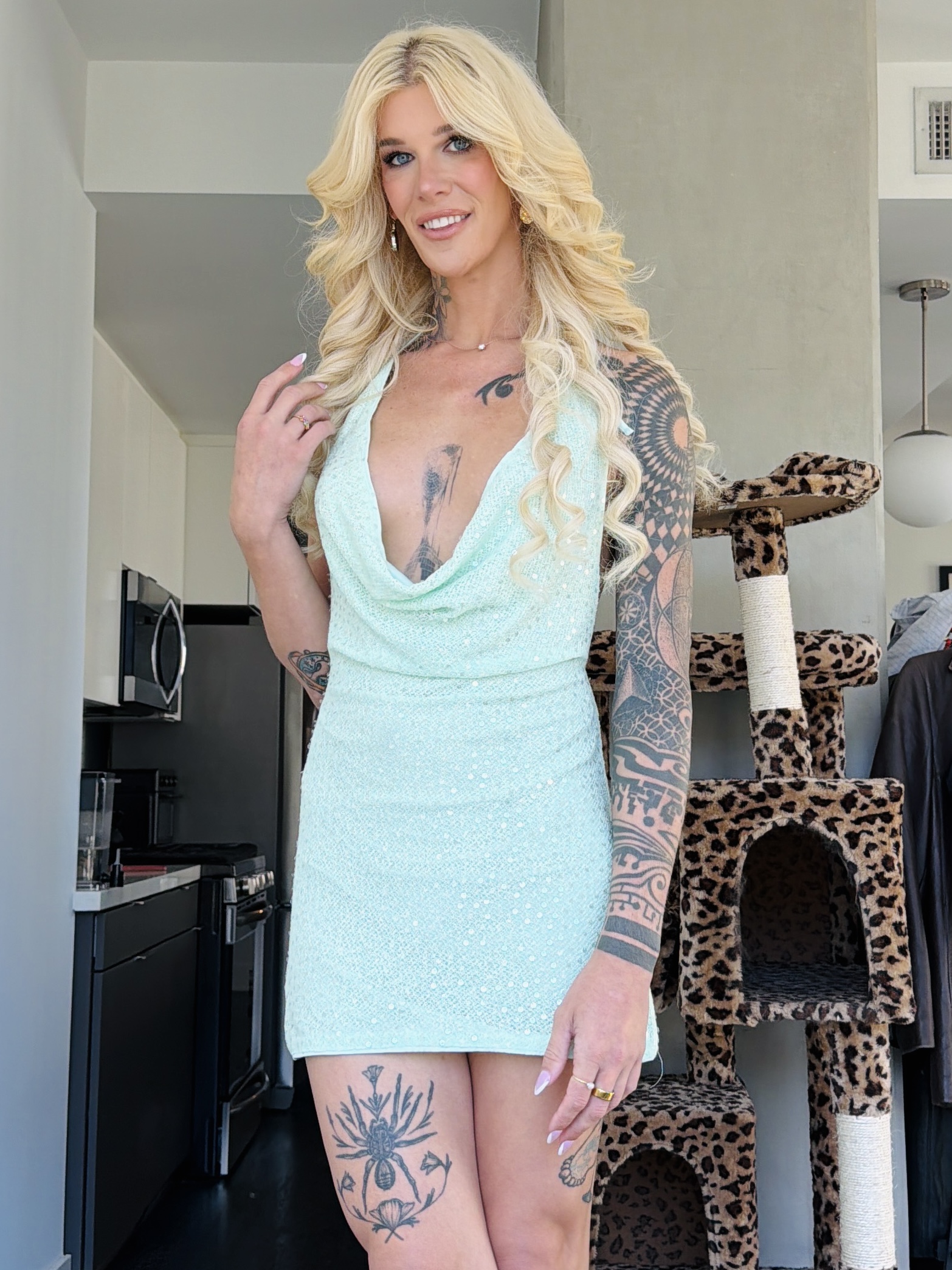
THE PERFORMER
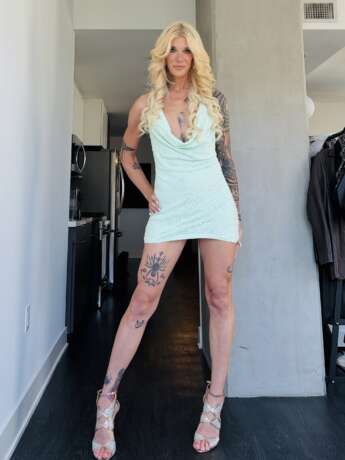
A year and a half into adult entertainment, Gray Perrier is winning awards, returning to the kink work that first interested her and developing a production company with her partner. The former nonprofit CEO talks about the paperwork behind the camera, a transition that began at 31, the education behind her BDSM practice and the work of making a successful career sustainable.
Interview/Feature: Sherman Wayez
CHICAGO, ILL.
THE YEAR THAT MOVED FASTER THAN PLANNED
Gray Perrier had studio work on her list of goals when she entered adult entertainment. She did not expect this much of it this soon. About a year and a half into the career, the bookings, nominations and awards have arrived ahead of her timetable. “Did I see it coming? Absolutely not,” she says. “I am grateful for every opportunity I’ve had.”
The conversation begins with a look at 2026 and the approaching 2027 awards season, but Perrier keeps returning to the decision that made the year possible. She spent six years as a nonprofit CEO, burned out, took a year away from work and reconsidered what she wanted. Adult entertainment became the career she chose after that pause, with an administrative skill set already in place.
Now she is making solo content, developing personal projects and beginning to build a production company with her partner. She is also shooting for kink.com, a booking that brings a longstanding private interest into her professional work. The pace has surprised her, particularly the number of studios hiring her repeatedly when she had expected some of those opportunities to take several years.
What matters most to her is that the change has worked. “I feel very fulfilled,” Perrier says. Working hard is familiar; feeling that the work belongs in her life is what she emphasizes. “It was the right call and it was a risk, but it was the right call.” The next question is how to keep doing it without exhausting herself again.

THE INTEREST THAT CAME BEFORE THE BOOKINGS
BDSM was part of Perrier’s life before the industry was. She had practiced privately for four or five years before entering adult entertainment and had also worked as a professional dominatrix. Content creation offered another way to pursue the interest. Pro-dom work, she explains, can be exhausting and taxing in ways that differ from making content or working on a set.
“I was originally gonna do a lot more BDSM content right when I started,” she says. That plan ran into the work people actually wanted to buy. Her BDSM material was not selling especially well on her subscription pages, and studios were not booking her for it. Other kinds of performances were becoming her calling card, leaving much of her kink life private.
By the interview, she had shot for kink.com about a month earlier and was scheduled to return that week. “A lot of my content is not BDSM and kink, but it’s very ingrained in my personal life,” she says. “So being able to bring that on camera now is, like, that’s just—I’m really excited to be able to showcase that more.”
She does not describe the change as discovering something new about herself. “It wasn’t what I was quickly becoming known for,” Perrier says of her early BDSM content. “It wasn’t selling super well on my pages. I wasn’t getting booked for BDSM shoots.” She kept much of that side of herself private, but says, “Now I get to express that more. So it’s a nice, like, a refresh.”
LEARNING BOTH SIDES OF THE DYNAMIC
Perrier began as a submissive. Dominant work came later, along with classes intended to build a professional skill set. Those classes also served her personal development: she wanted to understand the practices first, then consider how to bring that knowledge into her job. “I float between the two,” she says of dominance and submission, “and I absolutely love both sides.”
On the receiving side, she enjoys bondage, uncertainty and impact play. “I love the feeling of not knowing what’s gonna happen,” she says. She describes herself as an enthusiastic impact bottom and says she has had canes break during play. Providing an experience offers a different satisfaction: developing a scene with another person, shaping the exchange and taking an active role in its direction.
“It’s different kinds of fulfillment,” she says. Asked to choose which role turns her on more, she declines the ranking: “I wish I could say one or the other, but it’s both.” The attraction is not determined by a permanent label. She can enjoy either role, and she considers the definitions themselves a little enclosing when they obscure the fluidity of an actual relationship.
With her partner, she is mostly submissive, though they blur those lines too. “In my personal life, like, I mostly am submissive to him and that’s a dynamic that we love,” she says. “The definition of, like, Dom, sub, submissive, dominant—sometimes I think those are a little too enclosing.” She tends toward submission with someone she trusts, while leaving room for fluidity.


TRUST DOES NOT CANCEL CONTROL
When the question about whether submission is about giving someone control to do what they want. Perrier makes a careful distinction. “It’s not that I’ve given up control,” she says. She retains the ability to say no, stop or ask for more. What excites her is the trust she and her partner have developed, rather than the disappearance of her own authority.
“We’ve built this dynamic where I trust him to do anything,” she says. Their relationship has developed over five or six years, giving them a history that is different from a professional encounter. On a work scene, she is focused on the consent discussion and establishing what the scene will involve. At home, the trust comes from knowing each other over time.
“The trust that comes with that dynamic is the part that I am driven by the most,” Perrier says. She also separates BDSM from the assumption that it must end in intercourse. Sometimes sex is involved and sometimes it is not. Whether it belongs depends on the scene and what they are doing; she does not treat it as a necessary finishing point.
The distinction carries into her preparation. She describes many kink activities as involving danger and a corresponding responsibility to learn. “I’m not gonna put somebody in rope if I haven’t taken, you know, hours of classes and practice and, you know, worked with trusted people to work on those skills,” she says. Confidence has to come from preparation rather than a willingness to improvise.
THE CLASSES AND THE LIMITS
What surprised Perrier during her education was how many people presenting themselves as professionals lacked training. She is critical of the idea that domination amounts to regarding men as repulsive or inferior, or that watching a few videos establishes competence. At the same time, she recognizes why formal instruction can be difficult to obtain: classes are hard to find and can be expensive.
“Often we’re learning from peers or learning from ourselves through trial and error,” she says. “I wish we had more opportunities to change that.” She does not dismiss online instruction altogether. “There is value to it,” she says of YouTube videos. Her objection is to claiming full skill after watching a demonstration or reading a blog, particularly when misplaced confidence could injure someone.
Respecting the dynamic means learning more about what interests you and understanding what you are creating with another person. It also means distinguishing BDSM from assault. “Just because you’re a Dom doesn’t mean you get to beat the shit out of somebody,” Perrier says. A label does not supply consent, and physical action alone does not establish the relationship she is talking about.
“BDSM is not hitting somebody,” she says. “It’s the dynamic you’re creating.” Even a single scene with a friend or professional partner requires trust between the participants. She keeps returning to that responsibility because technical knowledge and interpersonal judgment have to work together; an activity can be familiar to the person providing it while remaining unfamiliar to the person receiving it.
Her own education has included her partner teaching her to crack whips, use a flogger and tie rope. He also helped her understand that skill does not mean knowing another person’s limits. Someone can ask for more without understanding what they are asking for, or without having enough experience to anticipate how they will feel afterward.
Marks are one example. “Marks have a lasting impact, right? Like, anywhere from temporary to permanent,” she says. “In those spaces marks can feel really hot, but maybe you get home and your partner, who was okay with the marks, wasn’t.” The response afterward may differ from the enthusiasm during play, giving her another reason to favor safety over a request to continue.
“It’s a very, very active and constant state of mind,” she says of monitoring a scene. Every strike and every wrap of rope requires attention. Someone wanting to be tied up for the look may have different experience from a practiced rope participant, and a requested harness may not be equally appropriate for both. The request is a starting point for judgment, not the end of it.
She also has her own threshold for what she will provide. If the other person wants to go beyond it, she still has to stop. “I need to fall back on protecting myself and my safety, both in that moment and long term,” she says. Keeping the experience within her limits protects the person she is working with as well as herself.

AFTER THE NONPROFIT OFFICE
The career change did not begin with a lifelong ambition to make adult content. “Never really thought about doing adult content until my early 30s,” Perrier says. “It wasn’t, like, a huge goal of mine. You know, I’ve always liked being onstage and, like, in front of people.” This particular job appeared while she was deciding what came after nonprofit work.
“I was a CEO of a nonprofit,” she says. Six years in that role left her burned out. She took roughly a year off work entirely, went to therapy and spent time considering what she wanted next. People she knew in the industry gave her a chance to explore the possibility before committing, which mattered because she understood that published adult material would remain available.
“Once you do it, it’s there forever,” she says. She appreciated being able to learn about the work and decide whether it suited her before stepping into it. Her background was far removed from the business: she describes growing up in the far northern Midwest, sheltered and surrounded by church life, with little access to adult-industry culture or transgender experience.
It was not until her mid-20s that she began exploring more of that world. The difference between her history and other performers’ can still make her feel out of place. “I grew up in, like, the far north of the Midwest under a rock in a church,” she says. “The adult industry was so—I mean, transgender people were so far removed from what I grew up with.”
“Definitely, it’s a career,” Perrier says. Once she decided, she intended to jump fully in. She also found an unexpectedly comfortable part of the job: the computer work. “I love spreadsheets,” she says. “I love computer stuff.” Administration was something she already understood, and it made the new career easier to organize even as she learned its unfamiliar demands.

THE BUSINESS BEHIND THE PAGE
Perrier did not build her plan around studio bookings alone. She believed few performers, including trans performers and cis women, could rely entirely on studio work. Subscription pages and independently produced content were vital. She knew that from the start, especially after hearing that her tattoos and age could make studios reluctant to hire her.
“If no studios hire me, no studios hire me,” she says of her approach. She believed she had something to offer and that someone would want to buy it. Independent platforms gave her a way to pursue that belief. The work also required taxes, learning about write-offs and keeping records, with lessons accumulated through mistakes rather than appearing automatically with the first upload.
One platform notification brought the value of that preparation into focus. The site said it lacked consent documents for people appearing in her content. The paperwork existed; she had not immediately linked everything where it was needed. She says she supplied the documents covering roughly 150 scenes within ten minutes, avoiding a problem that could have threatened the page.
“I want to protect myself and my co-stars,” she says. A missing document can affect more than one person’s income and work. “We’re running businesses,” she adds, and the records belong to that responsibility. Her description of the career change is practical enough to fit on a desk calendar: “Nonprofit work is paperwork and sex work is admin work.”
TOO OLD TOO TATTOOED AND BOOKED ANYWAY
Perrier entered the business at 35 and heard that she was already a MILF, that she might be starting too late and that she had too many tattoos. The repetition of the tattoo criticism struck her as absurd. A studio was free to decide she did not fit its site, but she was not going to turn that decision into a demand to change her body.
“I’m not gonna change myself or my body to cater to a job,” she says. “I am the most important thing here to me.” Her surprise at the opportunities was not a confession that she felt unworthy. “I know that I’m great at my job,” she says. “I’m beautiful. And I’m talented.” She also recognizes that many other people in the industry can say the same.
What she had not expected was for certain opportunities to arrive so quickly, or at all. She credits people who took an early chance on her with giving her screen time she could not have generated alone. Among the people she names are Susie Q and Michael Vegas, with an early connection helping lead to work with them that became a continuing professional relationship.
“They gave me my, like, a big scene,” she recalls, placing it about five or six months into her career. By the October conversation, that opportunity was about a year in the past. “I cannot thank them enough for it,” she says. The gratitude remains specific: the booking mattered, the people behind it mattered, and the work continued beyond that first chance.
She can trace some opportunities back to those decisions. Others are harder to explain neatly. “Sometimes we are given opportunities and we can really track it back to the how and the why,” she says. “And sometimes it’s just, like, you look back and you’re like, wow, it’s been a really fucking incredible year.” She also believes deserving performers do not always receive what they should: “All of us deserve so much more.”

THE CONTENT SHE WANTS TO MAKE
Asked why fans responded to her, Perrier starts with how little she tries to disguise herself. On her subscription pages, she often has no makeup on and simply appears as she is. “I just kind of show up,” she says, trying to “be as me as possible.” The approach does not mean that the production behind every piece of content is casual.
Femdom and giantess work are among the niches she enjoys. She takes the creative process seriously and resists the idea that an audience will accept anything as long as the camera is running. “I’d much rather spend a few days planning and a day of shooting this extravagant scene,” she says, then use distinctive angles to construct the giantess movie she wants to make.
“That’s more fulfilling to me,” she says. That investment can mean putting out less material, but she values the result more and believes fans can see the difference. The care is not always about pristine lighting or conventional polish. It is about making the content fulfill the idea behind it, whether that calls for an elaborate fantasy or something deliberately quirky.
“The best content for me is the content that leans into what it’s trying to be,” Perrier says. Lighting helps, but she does not believe every production needs immaculate lighting. If the intended result is weird, with unusual camera angles, she wants to follow that idea rather than insert a technique simply because other creators use it. She acknowledges that her camera work is not always perfect.
Viewers have complimented the uniqueness of some angles. Other preferences pull in competing directions: POV, glamour, more conventional views, hard light, soft light or simply unedited footage. She says there is substantial demand for the latter. Listening matters to her, but satisfying every request would leave her creating indefinitely to accommodate people whose preferences may contradict each other.
“Thank you so much for letting me know,” is how she receives the feedback. She may incorporate a suggestion when she wants to. Otherwise she will keep making content her way, with room for viewers to find someone whose approach better suits them. Asked whether she thinks as a woman or as a pervert when she creates, she answers, “I think like me.”
Her content choices include both what she wants to shoot and what she thinks will sell. That does not mean agreeing to material outside her boundaries. “I won’t do anything I don’t want to do,” she says. It means distinguishing a limit from a morning when she would rather not work. A scheduled collaboration can still be a job she needs to do even when enthusiasm is low.
She also enjoys custom videos. Asked for an unusual request, she recalls one involving inserting gummy bears and pushing them back out. The same example returns when she is asked what surprised her during the career: it was something she had not expected to do. Beyond that oddity, she names the larger surprise of being able to become the version of herself she wanted to be.
WHEN THE NOMINATIONS BECAME REAL
Perrier is still learning how to recognize the audience as an audience. Asked why fans seek her out, her initial inner critic suggests that people merely stumble onto her content. “I kind of still feel like I’m learning that,” she says of understanding her own recognition. Nominations provided evidence that something more deliberate was happening on the other side of the screen.
Being nominated for Best Newcomer at multiple shows happened earlier than she expected. She was on ballots with women who had been working for four years and were, in her view, finally getting deserved recognition. Some shows involved active pre-nomination efforts. At others, she missed the pre-nomination deadline and still appeared among the finalists, which made the support especially striking.
“There are people that care enough about my content and me,” she says of that realization. The nomination was evidence that viewers had taken action rather than simply encountered a clip. Repeat bookings offered another kind of confirmation. “They like me enough,” she recalls thinking when studios brought her back. The return invitation told her that the first opportunity had become an ongoing professional relationship.
Her first award experience was an XMA in January, connected to the Adult Time production she identifies as The Bottom Floor: The Second Coming. “It had, like, 40 actors in it. It was a huge production. So I was one of the supporting cast members,” she says. She also describes herself as an extra. Going onstage was a shared recognition, distinct from the individual award that followed.
The individual award was Creator of the Year at the TEA Awards. She remembers sitting stunned for roughly 30 seconds and needing encouragement to get onto the stage. “I was floored,” she says. “I couldn’t believe it.” Asked for the first thought that went through her mind, she says the thoughts were gone; she needed other people to help supply them.
THE ACCEPTANCE SPEECH SHE DID NOT PREPARE
Perrier had received awards and appeared onstage in her former career, but experience did not make her a composed acceptance speaker. “I’m notoriously terrible at acceptance speeches,” she says. She had not expected to win, had not written anything down and found herself trying to speak while the surprise was still happening. The result was exuberant and scatterbrained rather than polished.
She recalls holding the trophy near her backside and asking whether it was a butt plug. The joke was not a planned routine. “Myself in that moment was not composed,” she says. “I was elated and excited and I let people see it.” It fit the person she says she wants to show her audience, even if it did not fit a rehearsed acceptance speech.
The award also validated the labor that preceded it. “I had been working so hard,” Perrier says. “There was one week where I drove back and forth to and from Vegas to LA, like, four or five times, ’cause I’m a full-time student as well.” Classes required her return to Los Angeles, while shoots kept putting her back on the road.
Afterward, she received more bookings, including from studios that had previously held off. She understood the new interest as an indication that they saw her as someone who would stay. The award gave her satisfaction and opportunities, but it also coincided with a question about what the next phase should look like. She wanted to keep working hard with more intention about where the effort went.
FEWER APPEARANCES MORE PRESENCE
“I put in so much work and I was exhausted,” Perrier says. “How do I continue to put in so much work, but in a way that’s a little more sustainable for me?” She does not credit the trophy alone with changing her outlook. She describes a mindset shift built from recognizing mistakes and deciding where to spend her energy.
Early ambition meant wanting to attend every event. “I want to go to every event. I want to go to every award show,” she recalls thinking. “I went to award shows before I was nominated. Like, we need to be supporting each other.” That commitment could be rewarding when the schedule allowed it, but stretching herself too far made the appearances less effective.
“I want to be showing up to places and, like, be present for that moment,” she says. Fewer occasions can offer more if she is able to engage with them. She still puts in substantial work, but is more deliberate about what she accepts and what she does not. Recognition has not eliminated the need to manage time or made every invitation equally valuable.
She entered the industry expecting politics, interpersonal complications and hoops to jump through. Starting in her mid-30s helped. “If I would have stepped into it in my early 20s or even late 20s, I personally don’t think I could have stayed healthy,” she says. “And I don’t think I would have had longevity in the industry, just knowing my personality.” Experience helped her make different choices.
That assessment is about herself, not an argument that younger performers cannot manage the work. She is in awe of people doing it at an age when she believes she would have struggled. Every industry has politics, she says, and she hopes to participate fairly. Awards are fulfilling and she would like more of them, but they are not the whole measure of the life she is building.
She wants to care for herself, her partner and her dog, and be cared for in return. “Is my job taking away from me or adding to me?” she asks. Her answer is that it adds, even when parts are exhausting. The standard she keeps checking is whether the work fulfills her as a person and supports the relationships she wants to maintain.
THE BRAND ON THE POSTER BOARD
Perrier’s screen persona is still developing. “We’re the cake in the oven that’s jiggly still,” she says. When she began, she intended to bottom rather than top, particularly in work with men. Being trans, she points out, does not obligate someone to top. She expected that boundary to help define the career; the opportunities she received prompted her to reconsider what she wanted.
“I started getting a lot more bookings if I was working with girls, if I was working with trans girls, and if I was topping,” she says. That role had been less prevalent in her private life. “I had to make choices of, am I going to embrace that? Or do I not want to?” She chose to embrace it, helping shape the work she is now known for.
“It wasn’t exactly what I was planning or expecting to have the majority of my career be,” she says. Moving toward 2027, she wants to step more firmly into that role while bringing more BDSM and kink into her work. The process remains open-ended. “I think I’ll probably be baking forever, honestly,” she says, returning to the image of a persona that is still becoming.
The business identity had preparation behind it. Perrier had developed a brand before and learned what can happen without a firm grasp of it. Before starting this career, she made a large poster-board chart with her stage name in the center and bubbles around it: colors, clothing, words she would use and other elements describing the person she intended to present.
She still has the chart. “I got this huge chart that I still have that I go back to,” she says. When a decision becomes confusing, she asks, “Do we want to change this? Or is this what we’re happy with?” The chart gives her a starting point to revisit, rather than a promise to remain exactly the same.
THE RUNNER WHO LOVED SCIENCE
Perrier started in private schools and attended public high school in the northern Midwest. Science was her favorite grade-school subject; becoming a veterinarian is the one early career idea she remembers. “I ended up going to college pre-med,” she says. “And then I switched to nursing. And then I dropped out of nursing school and got my degree in social work.”
“Not popular. That’s for sure,” she says of high school. She was a cross-country and track runner as well as an academic. When she was not running, she was reading. She graduated as valedictorian and captained both teams. The picture she describes is of someone busy with her own pursuits rather than positioned at the center of the school’s social life.
“I was pretty much on my own,” she says. That solitude was not entirely a problem for her. “I love being alone. I love being by myself.” She recalls bullying directed at what other children perceived as gayness, though she was not out as gay. She had a girlfriend and presented as straight; transition would come much later.
Asked whether girls gravitated toward her because they felt less threatened, she does not accept the premise as something she can establish. She was not thinking about her friendships that way and does not know what her friends were thinking. At that stage, the expected future was conventional: finish high school, go to college, establish a career and build a settled life.
THE PANDEMIC AND THE NAME
Perrier began transitioning at 31, during the pandemic. She describes a period in which many people unexpectedly had space to sit with themselves and learn something, whether they wanted to change it or not. For her, that period led to recognizing she was trans. Asked whether transition was more difficult psychologically or physically, she answers, “Both. Both were brutal.”
Before facial feminization surgery, and before learning to love herself more fully, she experienced considerable discomfort with her body. Some surgeries became part of the process and others did not. Physical development could hurt; hormone changes affected her energy. She also remembers an unexpected craving for red meat, which she associated with changes in her hormones and iron levels, after previously eating little of it.
She ate a great deal of lamb during that period. The physical details sit alongside the longer work of becoming comfortable with herself. “Learning how to love myself in that way again was a journey, was a process,” she says. She does not describe either the medical changes or the emotional adjustment as quick, straightforward or complete at a single identifiable moment.
Her mother and sisters were supportive. Perrier wanted the decision to remain her own rather than become something shaped by other people’s input. When she called her mother to say she was trans, one of the first responses was, “So do I get to pick your new name?” Perrier remembers replying, “I love you, but no.”
A month or two later, her grandmother reinforced the family claim with a joke of her own: she loved Perrier, but thought her mother should have been allowed to choose the name. Perrier appreciated the support while keeping the choices personal. “This is my journey,” she says. Having people who cared did not mean she wanted a committee involved in making the decisions.
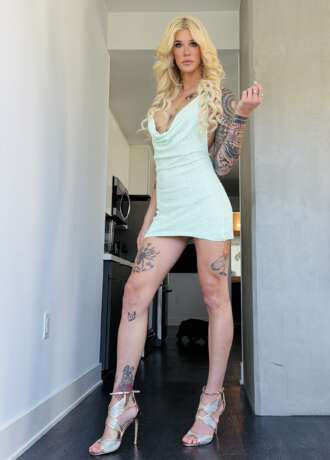
THE PERSON WHO GOT HER HERE
Perrier says her answer about her earlier self would have been different three years before the interview, when she had more desire to erase that past. “Now I have a lot of respect and love for the person who carried me through my first 31 years,” she says. “It’s the same person.” Her presentation changed, but she no longer treats her earlier life as something to discard.
“My journey didn’t reset,” she says. She recognizes that other people use the term deadname and should do what helps them feel comfortable. Her own relationship to that past is different. “He’s not dead to me,” she says. She feels grateful for having had an opportunity to change without treating everything that came before as something she must disown.
Two experiences helped her reach that understanding. One was entering adult entertainment. “I really had to embrace myself or I would lose myself,” she says. Decisions about how she performed and what work she wanted helped her accept her body and herself. The other was being loved by someone who did not require a different version of her.
She describes feeling genuinely beautiful as a trans woman for the first time: desired, held and accepted exactly as she was. That affection helped her ask a question she had struggled to answer alone. “If he can love me this way, why can’t I love myself this way?” she says. She still calls it a journey, but someone else’s acceptance helped her begin recognizing what she could not yet see.
Asked to imagine meeting her 18-year-old self, she does not pretend that the younger person would immediately understand the life she has now. “No. Absolutely not,” she says of being recognized. That distance coexists with the affection she has developed for her earlier self. She can acknowledge how much changed while continuing to see the life as belonging to one person.
WHEN SEX IS WORK AND WHEN IT IS HERS
Transition also changed Perrier’s relationship to sex. She describes different attachments to parts of her body at different points in her life. Early in transition, her interest in sex disappeared. When it returned, it returned strongly, leading to a period of greater sexual activity. She does not offer a dramatic explanation for that change: “My libido just came back.”
“In a relationship, I’m very monogamous,” Perrier says. “And out of a relationship, I am pretty fiercely alone. So it’s rare that I’m looking for a lot of continuity.” Occasionally she saw someone more than once, but the experiences varied with the person. She rejects the suggestion that her professional work offers a license to try everything sexually.
“When I am working, I’m not looking to experiment,” she says. On set, she uses what she knows and what will make a scene work on camera. Her personal life is where she can explore what she wants. Asked whether she prefers intimacy or sex without that emphasis, she says, “They both have their place,” without claiming to know exactly when she reached that understanding.
Separating personal sex from work sex took effort. “At times it was difficult for me,” she says. “I feel like I’ve only worked and I actually haven’t fulfilled sex for myself in months.” The balance is better now. Having a partner who also works in the industry helps her feel safer within their shared circumstances, reducing concerns about involvement outside that professional environment.
“When I am working, it is a job,” she says. “When I am not working, it is fun.” Work can be fun too, which she appreciates, but she does not assume it always will be. That distinction makes room for both enjoyment and obligation without requiring every professional encounter to serve her private desires.
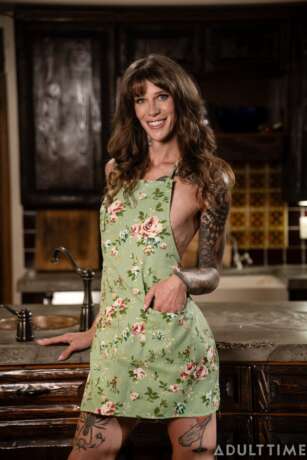
THE LIFE OUTSIDE THE FRAME
The off-camera list is ordinary and varied. “I roller skate. I like to crack whips. I garden,” Perrier says, adding yoga as she runs through what she does with time away from work. “I used to read. I don’t really do that anymore. I like to bake. I bake cakes.” Those interests sit alongside school, work and the relationships she wants the career to support.
Her estimate of the job’s reality is considerably less glamorous than the popular image. “90% of my job is at a computer,” she says. “Less than 10% of my job is fucking.” She likes sex, but she did not choose the career to sleep with the most attractive people available or make the rounds of potential partners.
“For me, this job has really been about, like, how can I find a sustainable life for myself and my family?” she says. She is aware that outsiders may picture a nonstop orgy. Her experience is a job she enjoys, with substantial work required away from a set. “My job is not my life,” she says. “And that’s the distinction that’s important to me.”
STAYING HERSELF WHILE THE TOOLS CHANGE
AI has not affected Perrier especially directly yet, but she is uneasy about where it may lead. “I don’t love it,” she says. She points to marketed AI sexual companions and the prospect of AI taking over creators’ accounts. These are concerns about the business around her, rather than claims that she has already experienced a particular financial loss or account takeover.
“I think we’re going to quickly see the damage that it’s causing,” she says. She anticipates changes arising from platform rules, AI regulation or the audience’s own response, whether viewers become fed up or decide they want more of it. She does not claim to know which response will prevail, only that the effect will become more apparent.
Her own intention is less uncertain. “I am going to keep being me, even if it would be easier to be a robot,” Perrier says. For a performer who puts so much emphasis on showing up as herself, that is also a practical statement about how she wants to continue creating. The interest in new tools does not replace the person she intends the audience to encounter.

VISIBILITY DESIRE AND THE NEXT YEAR
Asked why trans content remains popular, Perrier offers her view of the relationship between taboo, visibility and desire. She sees trans issues becoming more prominent over a period of years, through rights discussions and political controversy. She also refers to political declarations denying trans people’s existence, describing the hostility as part of the attention surrounding the category rather than endorsing those claims.
“Topics in the world can create desire,” she says. Taboo can make a viewer feel they are doing something transgressive, while greater visibility can help other people recognize desires they had not previously been able to explore. She sees both forces operating together, with viewers approaching trans content from different motives. “For either hate or love,” is how she describes the range of attention.
The approaching awards season is another opportunity she welcomes without treating the result as settled. “I would love to be onstage again,” she says. “And if I’m not, then I get to support the people who are.” Personal content and projects remain priorities, and the production company with her partner is still in its earliest stages. They are building out their shooting space now.
She does not announce a company name or a finished launch. What she has is work underway and enthusiasm about the possibilities. She also suspects the highlight of 2027 could be something she does not yet know is coming. That uncertainty has precedent: the studio work she once expected to take years already arrived much faster than she had planned.
Fans can find her sites at grayperrier.com. “Almost all of my websites are just at Gray Perrier,” she says, spelling it G-R-A-Y-P-E-R-R-I-E-R, “like the color, like the water.” The site gathers her platform links. “If you see me out and about, please feel free to say hi,” she adds. “I love meeting my fans.”
“Thank you for being here, sticking with me,” Perrier says. “I literally can’t do my job without you.” If someone sees her out, she wants them to feel free to say hello; she loves meeting fans. The career has given her recognition, a developing business and a way to feel more like herself. “Let’s see what next year brings us,” she says.
Follow Gray Perrier on X at https://x.com/grayperrier and on Instagram at https://www.instagram.com/
Website: grayperrier.com

Follow us on twitter: @emmreport, instagram @emmreport, tiktok@emmreport







+ There are no comments
Add yours