

THE CREATOR
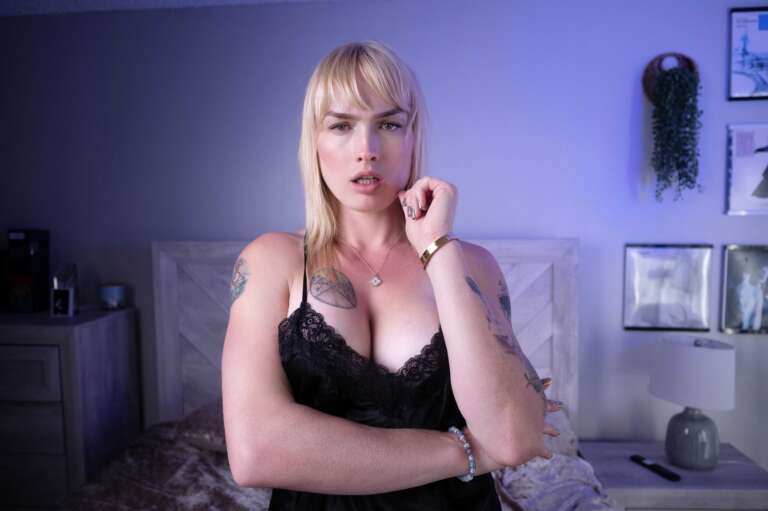
From a German childhood filled with music, art and self-expression to tattooing, live camming and an unexpectedly intense role in Camgirl, Sally Dinosaur has turned curiosity into a career built around control, provocation, vulnerability and the stubborn belief that the most compelling performance is the one that still feels real.

Interview/Feature: Sherman Wayez
A Workaholic Learning to Stop

Update: Congrats to Sally being named Most Authentic Creator of the Year At the Venus Berlin Awards show
CHICAGO, ILL. — Sally Dinosaur begins from an unusual place for someone whose life is built around constant creation: she is trying to slow down. The German-born creator is starring in Cam Girl, directed by Jeffrey John Hart, produced by Holly Randall and Stripchat, a project that has become another major step in a career driven by creativity and constant reinvention. Back home in Cyprus with her dogs after months she describes as “crazy stressful,” she says she is finally attempting to enjoy life before another round of work and travel. Even her favorite destinations reveal the contradiction. “Definitely Miami. I love Miami,” she says, while Los Angeles feels more like somewhere she could actually live. Miami, by contrast, is “like paradise” and “never closes”—which may be precisely why it appeals to her. “I can’t just sit there and do nothing,” she admits. “I need to learn how to relax more.” Asked whether she is a workaholic, she doesn’t fight the label: “Yeah, I would say so. So my friends say so.”
The engine underneath that work is not attention, she insists, but creativity. “It’s more the creativity,” she says. Before online content, she worked as a tattoo artist; before that, as a makeup artist. “Everything with a lot of creativity, I’m all in,” she says. “That’s my biggest motivation to just stand up in the morning and do something.” Born in Germany, she remembers music and art as favorite subjects, drawing on herself, using temporary tattoos and imagining art on her body long before it became part of her adult identity. Her father, she jokes, would probably say the creative impulse was there “when I was born.” She drew, wrote and even tried writing English song lyrics while still learning the language.
The ideas arrive with urgency. “I need to do it immediately,” she says. Leaving an idea sitting in her head can “drive me crazy,” particularly because the finished result has to meet her own exacting standard. “I think [I’m] a perfectionist.” Inspiration can be almost anything: a smell, a candle, a color combination, an outfit, a song, a movement. What she needs is enough structure to protect the freedom to follow those sparks. Eight hours of sleep matters; morning and evening routines matter. In between, she wants the day open enough for creativity to happen.
That balance has become harder as the work has grown. Travel, appointments and large projects can consume the same mental space she needs for her own ideas. “Sometimes it’s hard to focus on the creativity part of myself, my own projects,” she says, especially when she is immersed in something as demanding as a movie. The tension between relentless work and the need to preserve herself will surface again and again in her story—and, eventually, inside the character she plays on screen.
Provocation, Confidence and the Girl Who Looked Different
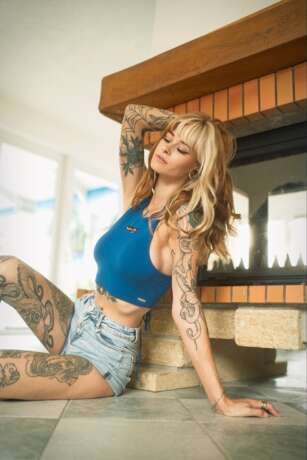
Sally says her creativity was always “a little sexy and spicy,” in part because she enjoys provocation. “I’m like an open book,” she says. Long before followers and platforms, she liked sending a teasing message or image at precisely the inconvenient moment, knowing the recipient would have to carry the thought around. The pleasure was partly imaginative: “You have it in your head now. Do whatever you want to do with it.” Feedback taught her that the effect was real. “You drive me crazy,” people would tell her. “I think that’s definitely something or a point where I notice, okay, it works.”
That confidence did not begin as conventional self-assurance. In school she wore bright blue, pink and other colored hair and looked, in her words, “more like a goth girl.” At the time, she says, the look was more likely to be treated as strange than fashionable. It was not rebellion for an audience. “No, it was just me,” she says. “How I felt from the inside, I just expressed myself with that.” Even now she resists the idea that she simply looks in a mirror and sees what admirers see. “I’m not the biggest fan of saying I know that I’m attractive,” she says. The confidence came gradually, through making pictures, recognizing the days when she liked what she saw, and learning how to reproduce that feeling.
School also supplied the name. Skinny as a child, she struggled with a judo roll because her spine hurt against the mat. Other students compared her to a dinosaur as an insult. She took the word back. “Okay, then I’m a dinosaur. Now I’m the dinosaur,” she remembers. It is a compact version of a pattern that would follow her into adulthood: something meant to make her feel strange becomes material for an identity she controls.
Private Kink, Public Persona
Her curiosity about sexuality developed with the same instinct to experience rather than merely observe. She remembers watching kinky material and realizing, “I just don’t want to watch that. I also want to recreate it or do this in my real life.” She describes herself as naturally submissive in sexual settings and says empathy made those images especially powerful: she could imagine what the performer was feeling. “I really felt connected,” she says. She later experienced a D/s relationship, including collars and more intense private dynamics, but deliberately kept much of that life separate from her public content.
The distinction matters to her. “It was too private for me,” she says, explaining that certain experiences were about a feeling shared with a trusted person rather than something she wanted to translate into content. She remains interested in kink, although she jokes that elaborate rope work can demand more time than she wants to give it now. Submission, for her, can function as relief from the rest of her personality. “The rest of the day, I’m just so focused creating something,” she says. In a trusted scene, handing decisions to someone else can quiet that part of her brain.
Trust is the nonnegotiable element. She talks openly about rougher play, restraint, fantasy and consensual power exchange, but repeatedly returns to the person on the other side knowing what they are doing. The attraction is not carelessness; it is the ability to surrender inside an agreed structure. Even when discussing a consensual non-consent fantasy, she emphasizes that the premise is negotiated in advance and rooted in trust. The fantasy works because, within it, she can feel helpless while still knowing who the people are and why they are there.
Camgirl Changes the Scale
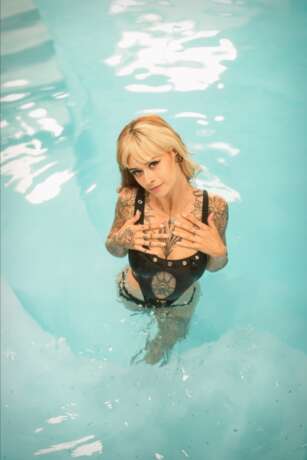
That same combination of trust and curiosity helped pull Sally into Camgirl. She says producer Jeff approached her about the project around Venus Berlin. At first, the word “movie” did not mean what it would eventually mean. “I thought it’s like a long sex scene only, maybe with a little bit of role play,” she says. What emerged instead surprised her: a conventional narrative production structure combined with real sex. “It’s a completely different thing,” she says. The concept made sense to her as a more explicit extension of films that suggest sexuality without showing it.
At the time, she was primarily a cam model producing her own material rather than working through adult-film production companies. “I was working as—or still—as a cam girl and producing my own content,” she says. Traditional studio ambitions had never been a major plan. Her tattoos, she believed, made her an imperfect fit for some glossy brands, and independence mattered more anyway. “I still love to decide what I want to sell to people,” she says. “I’m my own boss and I can decide.” Yet the experience of Camgirl changed one thing decisively: after making it with Jeff, Kyle, Rafa and the team, she knew she wanted to do more projects in that creative lane.
Her first reaction to the invitation was uncomplicated. “Yes. Yes, I’m in. I trust you,” she remembers. That trust had been earned through earlier shoots. She had watched Jeff work close to the action, obsessed with detail, and saw footage on a large screen that made her want to keep watching herself rather than turn away. Later promo shoots reinforced the connection. “It’s so easy to work with him,” she says. “I really feel that he’s loving his work. And that’s really giving a lot to the model as well.”
The Camera as a Scene Partner
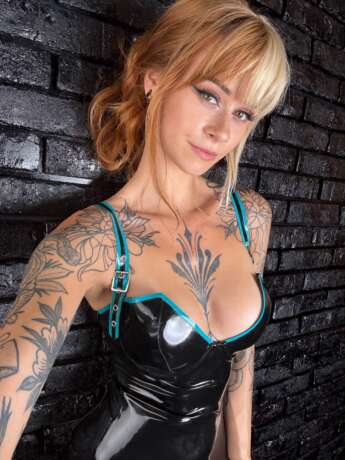
Sally does not simply pose for a lens; she watches it, anticipates it and plays to it. “I always tease the camera,” she says. Live camming trained her to see herself as the viewer sees her, and even when she cannot monitor an image, she studies the lens and its movement. If a camera drifts down her body, she understands what it is framing and adjusts without needing a string of commands. That fluency became particularly useful with Jeff, whose visual instincts she learned to trust.
The two also share a perfectionist streak. Sally describes a production rhythm in which an idea could change from A to B, require a new lens and a complete reset, then suddenly return to A. The phrase “actually, no” became a running joke. Still, she understood the obsession. “We knew already it was maybe the 10 out of 10, but he knew he can get the 11 out of 10,” she says. Repetition in the Cyprus heat could be exhausting, but she now sees the results as justification for the extra takes.
At times the process pushed her beyond what she thought she had left. “I don’t know if I can do it like one more time,” she remembers saying after a take she believed was already her best. On the final day, the team finally convinced Jeff that one difficult shot could not realistically be improved. His acceptance hit her unexpectedly hard. “I started crying immediately because it was so emotional that it’s not perfect for him,” she says. Even then, she laughs, tears could become material: “The tears now—give me one more.”
When Acting Stops Feeling Like Acting
Camgirl asked more from Sally than camera awareness. Her character is named Sally, but she is not simply playing herself. The fictional Sally is pulled between partying and a more organized, ambitious life, eventually confronting the damage of her choices. “She has to decide, is it this way or is it that way?” Sally explains. The role became difficult because one part of the character did overlap sharply with her own recent experience: overwork and burnout.
She says she had gone through burnout only months earlier after working too hard and failing to take care of herself. Reentering that emotional territory for the movie made the performance unusually personal. “I think I could do it really in an authentic way because I already knew how it felt,” she says. One scene stayed with her after she went home. She cried, called a friend and had to remind herself that the bleak life she was feeling belonged to the role, not to her actual present. “I can’t sleep because I think the world is gray and black,” she recalls of that emotional spillover.
The crew learned when not to pull her out of it. During a particularly sad sequence, Sally asked everyone to leave her alone during breaks rather than joke with her, because she needed to preserve the emotional state. Jeff adjusted too, speaking more quietly before a sunset one-shot so the performers could remain inside the scene. “He acted with us,” she says of the way he managed the mood. Asked whether “one shot” really meant one shot with Jeff, she laughs: “No, it’s definitely not. Give me one more—it’s like, give me five more.”

Cyprus Becomes Part of the Movie
The production also changed Sally’s relationship with Cyprus itself. She had moved there about a year earlier but admits work kept her from exploring much of the island. Camgirl forced the issue. “For the movie, we needed every single sunset place there is,” she says. Drone footage and location work made her see the landscape differently. “It was just beautiful to fall in love with this island more and more with every shot,” she says. “I can call it home.”
The sexual scenes were similarly grounded in familiarity. She describes three principal setups: boy-girl, girl-girl and a solo live-streaming scene tied directly to her cam persona. The solo material was naturally the easiest because it resembled her everyday work. The girl-girl scene, with Jules Blue, also flowed easily after they discussed boundaries and preferences. “Then we were just having fun when the camera just started recording,” she says. The boy-girl scene required more adjustment because her scene partner was less comfortable with cameras.
What mattered was preserving the sense that the encounter existed first and the camera was simply invited into it. “It was just a real situation and adding the camera,” Sally says, contrasting that with constructing a camera setup and then forcing people into it. “This is how I produce my videos all the time—real situation, adding a camera.” That sentence may be the cleanest description of her larger creative philosophy.
Learning From a Feature Set
Working on Camgirl expanded Sally’s ambitions beyond the project itself. She watched how beauty shots, drone shots, lighting and narrative coverage could make even familiar spaces feel more cinematic. She began thinking about how to bring some of that polish into her own content without losing the intimacy that makes it hers. She wants work that feels “more professional,” she says, even when it is filmed in her own bedroom.
She also came away with a deeper respect for how much planning a feature requires. Beforehand, her mental model was closer to role play with lines attached. The actual process was larger, slower and more collaborative than she imagined—and, she says, better. “I couldn’t really tell how it is to shoot a movie,” she says, but the finished experience exceeded the picture she had in her head. She found herself absorbing angles, visual ideas and production habits she could adapt rather than simply imitate.
That instinct is consistent with how she approaches nearly everything: watch, experiment, learn, then make the technique personal. Whether she is studying a camera move or taking an online course simply to understand a world she may never professionally enter, curiosity is part of the job. Camgirl did not turn her into someone waiting for a studio to define the next step. It gave an already independent creator more tools.
The Look Is Not a Costume
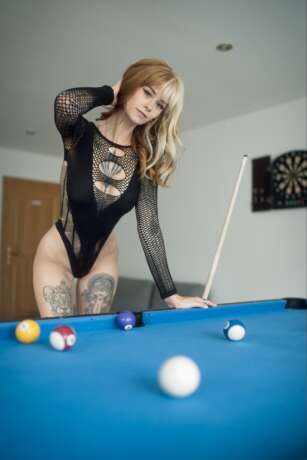
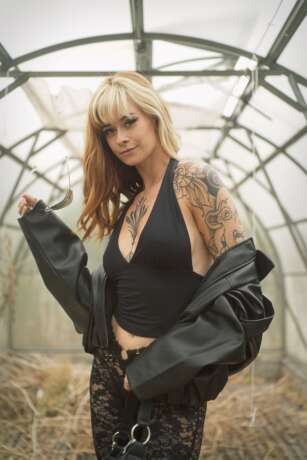
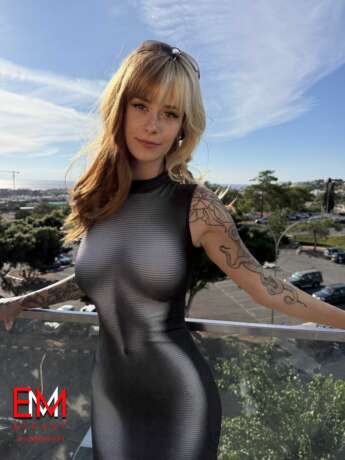
Sally’s tattoos are among the most visible parts of her image, but she resists turning every piece into a symbolic autobiography. She started getting tattooed at 18 after years of drawing designs on herself. Some pieces exist because she likes how they look. “I think it’s beautiful, so this is why I got it,” she says. She has avoided names and other choices she expects she might regret. On Camgirl, the tattoos were rarely an issue; one wardrobe change at a dark beach club was mainly about making sure black fabric did not visually disappear into the tattooed skin.
More important is what the tattoos do to her sense of her own body. “You never feel naked with them,” she says. After living with them long enough, she notices the blank areas more than the tattooed ones. “I only see those blank spaces on my body,” she says. In a bikini, tattoos can feel almost like clothing: “It feels hugged from the tattoos.” The look that once marked her as strange at school became the surface in which she feels most at home.
She never built that appearance to satisfy a market. Two-tone hair, piercings, tattoos and unusual clothes were there before the audience. She remembers wanting a septum piercing at 14 and piercing it herself when she was not allowed to get one, and stretching her ears for the same reason. The industry lesson, eventually, was not to sand those details away in pursuit of an easier “girl next door” identity. The better strategy was to become more fully recognizable as Sally Dinosaur.
She Started Camming to Prove She Would Hate It
Her entry into camming is almost comic in retrospect. A friend told her how much fun it was, and Sally was convinced the format did not suit her. “I could never be sexy all the time,” she remembers thinking. She planned to try it for roughly half an hour as proof. Instead, her first session stretched to about four and a half hours. “I fell so in love with it,” she says. The immediacy changed everything: compliments arrived in real time, viewers could interact, and she did not have to maintain a single manufactured mood.
What viewers responded to was the mix. She could joke and talk like a conventional livestreamer, then shift into something “spicy.” “You’re so authentic,” she remembers people telling her. The audience felt they already knew her, but now they could interact with a sexual version of that same person. Private shows initially felt stranger; in one of her first, the customer mainly wanted to talk while she was prepared to perform. That reversal taught her that camming was not simply a sequence of sexual acts. It was a live relationship with an audience whose expectations could change minute by minute.
Over time she experimented with different spaces, formats and levels of risk, from bedroom streams and a kitchen counter to outdoor shows after moving somewhere warmer. She describes the process as constant “learning by doing.” Every stream can change the next one: a viewer suggests something, a tip menu changes, a profile picture changes, a new content idea appears. The work is iterative, personal and never quite finished.
Sally On, Sally Off
Some performers describe an on-camera alter ego that disappears when the recording ends. Sally says that separation does not fit her. She can intensify a trait for a scene, but the person is still recognizably her. The openness, humor, teasing and awkward moments are not errors she needs to edit out of her personality. They are the reason the audience believes it knows her.
That does not mean everything is public. She is deliberate about where private experience ends and content begins, and she can choose different power dynamics online than she prefers in intimate life. But she rejects the idea that authenticity requires showing every detail. What matters is that what she does choose to show is not a fake personality invented for conversion. “I’m just too real,” she says later when explaining why fans trust her claims about new content.
The approach has a business consequence. Recognition is no longer only about follower counts; it is about a visual and emotional signature. People may recognize the two-tone hair or tattoos before they remember where they saw her. Others feel they know her because of how directly she speaks. That familiarity can be more valuable than generic polish. Sally’s brand, in other words, is not a costume. It is continuity.
Sex, Control and the Value of Enthusiasm
The interview eventually circles back to sex in unusually candid detail, but Sally’s answers remain consistent with everything she has said about work and creativity: enthusiasm matters more than choreography. She talks about oral sex, edging, power exchange and the push-pull between feeling dominant and submissive. She enjoys being able to provoke and control a partner’s response, yet she also likes moments in which the other person takes control. “It’s kind of both,” she says. The appeal is not a fixed role so much as the tension between roles.
She is equally clear that technical skill without desire is not enough. Asked whether she would rather have sex with someone who is completely into her or someone who is simply good at sex, the answer is immediate: “Totally into me.” She says the same principle applies when a partner is focused on her pleasure; if the other person seems to be performing a duty, the experience collapses. “When you enjoy it, I enjoy it as well,” she says. The camera does not fundamentally change that equation.
That is why she pushes back on the assumption that a public sexual persona automatically means an endless private performance. Her filmed encounters can be real, she says, but they work because the chemistry is real too. The fantasy can be elaborate; the person still has to be present. Imagination is powerful enough that reality often struggles to compete. “Ninety-nine percent of the time it’s better in here than in real life,” she says, pointing, figuratively, to the world she has already built in her head.
When a Hobby Becomes a Career
For Sally, the hardest question may be where ordinary life stops and work begins. “When is it stopping being a hobby?” she asks. Once a hobby makes money, people call it a job, but her process often consists of doing something she would naturally do and adding a camera. Travel illustrates the blur. Most of her trips are for work, but when the job is finished in Miami she may rent a boat or go shopping—and then film content on the boat or make a shopping vlog. “The whole day is a combination of work and normal life,” she says.
She knows outsiders sometimes dismiss sexual content as something other than labor. Her experience is the opposite: streaming, production, planning, travel, interaction, experimentation and the emotional swings of audience response all accumulate into a career. A weak month can trigger self-doubt. A new idea can reset the momentum. “You always start to compare these months,” she says, asking herself what worked, what should change and what people want to see.
Even the people from her past occasionally reappear inside the audience: former schoolmates, an old neighbor, a tattoo artist and others who knew a different version of her. That can feel strange because the relationship does not begin from zero. With strangers, she can decide how Sally Dinosaur is introduced. With someone who remembers tenth grade, the public and private timelines suddenly collide.
The Ten-Year-Old Sally Would Know Her
Near the end of the conversation, the question turns backward: would the ten-year-old version of Sally recognize the woman she became? She hesitates because so much has changed, including her appearance, career and country. Then the through-line becomes obvious. She was the girl dyeing her hair, drawing on herself, wanting piercings and imagining a body covered in art. The adult version is not a betrayal of that child’s imagination. “I look like the perfect version of what I expected myself to be when I was 10,” she says—not literally, but in the image of tattoos, colored hair, piercings, smiling and happiness.
The thought makes her emotional. She imagines that younger Sally looking up at her now, “kind of tearing up,” proud that underneath everything she is “still Sally in a different way.” The qualifier matters. She does not claim to have reached some final form. “She learned so much in the last years,” Sally says, “and yeah, that’s not the best version of herself, but she’s working on it.”
Her message to fans begins with the simplest possible line: “Love you all.” Then she explains why. They have stayed because, she believes, they recognize the passion behind the work and trust her not to invent a fake superlative every time she has something new to sell. They like, share, comment and defend her when strangers reduce what she does to stereotypes. “They’re supporting me,” she says. For someone whose career began with the conviction that she could never stay sexy on command, the irony is perfect: what made the career work was discovering she never had to. She only had to keep being Sally.
ALL SALLY LINKS: https://link.me/sallydinosaur.vip
Web Site: sallydinosaur.com
Free Telegram: t.me/sallynaughtydi
Stripchat on X: https://x.com/stripchat
CAM GIRL The Movie on X: https://x.com/Camgirlthemovie

Follow us on twitter: @emmreport, instagram @emmreport, tiktok@emmreport




+ There are no comments
Add yours