
THE OUTSIDER
A married suburban father with no film experience turned a COVID-era fantasy, a financial collapse and an obsession with music into a 15-day adult production built to challenge the industry and call attention to climate change.
Interview/Feature: Sherman Wayez
CHICAGO, ILL. —
The Idea That Would Not Let Go
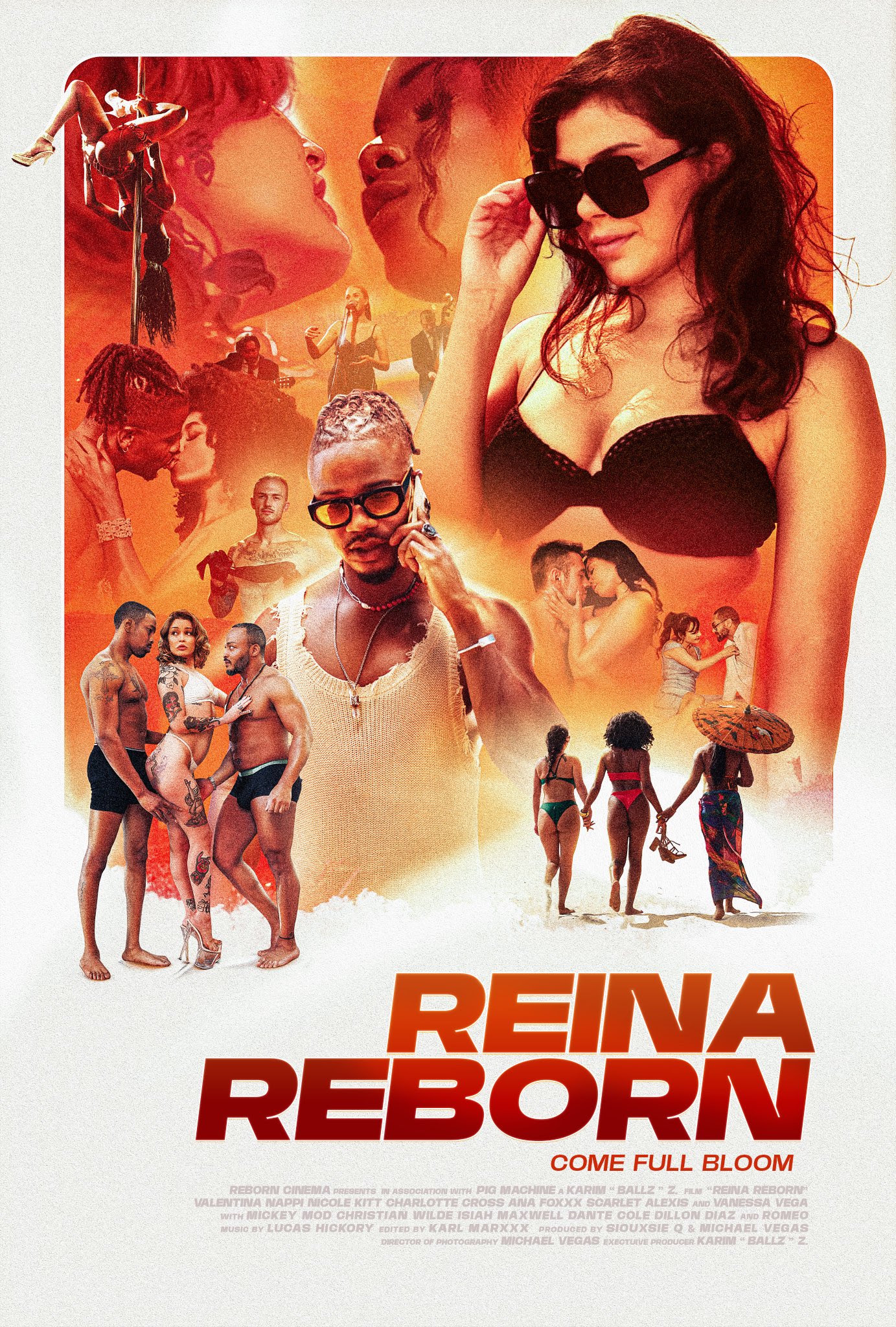
Before Reina Reborn became a film, a website or a production involving more than a dozen shoot days, it was a private obsession in the mind of Karim Z., a married suburban father with no filmmaking experience, no adult-industry experience and a regular job that could never be allowed to know. He had spent years more comfortable outside the spotlight, and even during the interview he explained the sunglasses by saying, “I’m not really faced forward.” Yet the project forming behind them was anything but discreet: an ambitious, music-driven adult feature designed to look unlike anything else in the business.
The first spark arrived during COVID, when Karim says he had money, family around him and more free time than most people. He was making money trading cryptocurrency and thinking about a drinking sequence from Lock, Stock and Two Smoking Barrels whose cutting, camera movement and music had stayed with him. “I always just loved the way it was cut,” he says. “I loved the camera movement. I loved just the style, the way the music went with it.” His transgressive variation was immediate: instead of characters gorging on alcohol, he imagined a music video built around “gorging on cock.” At first, it was only a passing thought.
Then the comfortable version of his life collapsed. Karim says he lost the money he had made, still owed taxes on the previous year’s gains and returned to an office five days a week. “I had all this money. I had all this time and I did nothing with it except just piss it away,” he says. “And now here I am in debt and realizing that I pissed it all away.” Through what he calls “a series of miracles,” he rebuilt some wealth, but the loss changed what the recovered money meant. He wanted to use it before it vanished again, and he wanted the result to matter.
By then, the idea had expanded far beyond one music video. The drinking-scene riff became the opening feast in Reina Reborn, and Karim began imagining a full feature that could hold spectacle, music, sex and an environmental purpose inside the same improbable frame. “This whole idea had just been expanding and expanding in my mind,” he says. Looking back, he describes it with unsparing clarity: “It really was just a manic, crazy idea.” But he also remembers the conviction beneath the mania: “I think I can make an awesome adult film.”
A Marriage Negotiates the Impossible
The first production battle took place at home. Karim’s wife was not interested in adult content, did not see pornography as consistent with her values and had children to consider. “It was a little bit of a hurdle to convince my wife to let me go through with this idea,” he says with considerable understatement. He also identifies the mental-health context directly: he is bipolar, was “a little bit hypomanic” and knew that state could make him hypersexual, obsessive and unusually certain of his ideas.
He would raise the project, watch the conversation become painful, then leave it alone for months before returning to it. “She thought I was completely insane, and rightly so,” he says. From her perspective, the proposal was not merely unconventional. Her husband had no film background, no adult-business background and no practical reason to believe he could make a feature. “It was hard for her to believe that I was actually serious about wanting to make an adult film,” he says. “It’s an absurd idea.”
Eventually they reached compromises that allowed him to investigate whether the film was even possible. One condition shaped the earliest shoot: Karim stayed away from the set. Another shaped the entire plan: this would be one film and nothing more. His wife never became enthusiastic about the world he was entering, but she recognized the depth of the commitment. “She eventually came around because she saw how much I believed in it and how much I wanted to do it,” he says. “Reluctantly really ended up supporting it.” He calls her “an amazing, amazing woman” who stood by him through a project that was “very, very hard pill for her to swallow.”
Brazil Without Portuguese
Permission to explore did not make Karim’s first plan any less improbable. “This is how crazy I was,” he says. He wanted to shoot in Brazil, with Brazilian performers, in Portuguese—a language he did not speak—in a country he had never visited. The concept fit the film’s imagined atmosphere, but practical reality arrived quickly. “I did start exploring that,” he says. “It became apparent that that wasn’t going to work out.”
He redirected his search toward the American industry and learned what happens when an unknown man contacts established professionals to announce that he intends to direct an adult feature. “The vast majority of people I reached out to did not respond,” he says. He had been an adult-content fan since before puberty, had encountered feature-length films in his father’s hidden collection and considered himself selective about what he liked. None of that amounted to production knowledge. Asked whether he researched the business first, his answer is essentially no: “I was kind of learning as I went.”
Karim filled out contact forms, contacted producers and directors, and even reached toward Erika Lust’s operation before looking into custom-video producers. One woman answered. Her work did not appear to match the scale or quality he envisioned, but she was the only viable doorway. “I had no other choice and I really wanted to do this,” he says. The partnership would not last, but her response indirectly led him to the people who could make the film real.

The Accidental Michael Vegas Connection
When Karim asked the custom producer for examples of her work, she sent a film in which she did not appear in the credits. He began contacting credited participants to confirm her role. Only Michael Vegas answered, saying he did not remember her. Their exchange drifted from a reference check into Karim’s larger ambition, and Vegas showed interest. Karim, still loyal to the arrangement he had already begun, initially turned down the person he would later consider ideal. “He was the perfect person for me to make this film with,” Karim says. “And I turned him down.”
Vegas had also sent a reel that Karim somehow missed. A month later, he found it. “I was like, oh my God, this is the guy I need to be working with,” he says. Karim proposed that Vegas join him and the custom producer as a team. Vegas agreed to try, although he normally stayed within his own production group. Then the original producer ended the arrangement herself after Karim insisted he would direct and be present on set. “She actually ended up rejecting me,” he says. “Which was perfect because I didn’t want to just fire her.”
With that obstacle removed, Karim flew to Los Angeles to meet Vegas and Susie in person. The trip was partly creative and partly proof of seriousness. “I really want to do this,” he remembers telling them. His script existed, but he admits it was “pretty rough” and not in professional format. Their writer reshaped it into a workable screenplay, while conversations began about scenes, sets, performers and logistics. Karim had found collaborators capable of translating obsession into production, but he had also reached the point where every missing piece of his education would become visible.

Learning a Film Set in Real Time
Karim’s central act of confidence was also his central act of recklessness: he believed he could learn by doing. “Somehow I thought I could just jump in head first and do everything,” he says. “Obviously there was a lot for me to learn that I should have bothered to take the time to learn before I [did] it. But I didn’t.” He says he paid a price for that approach, yet it also kept the project alive; a more experienced businessperson might have calculated the risk and stopped.
The gaps became concrete when gaffer Joel Sinclair asked what lighting he wanted. “I was like, I don’t know. You tell me,” Karim says. Even the feast sequence that had started the entire project exposed the distance between having a visual reference and speaking the language of a crew. He could describe the feeling, but not always the shot design. In hindsight, he wanted far more camera movement. “There’s things that I didn’t know how to express,” he says, including “what kind of shots I wanted.”
He was more confident with dialogue than with the mechanics of sex-scene coverage. “I didn’t interrupt the sex scene much at all,” he says. “But when it came to dialogue portions and other shots, I was very much involved.” His first day physically on set involved Vanessa Vega, Isaiah Maxwell and Dylan Diaz. The earlier Bruce Venture scene had been filmed without him as part of the compromise with his wife, and it came out close to the plan because of extensive preparation. That success gave him evidence that direction could happen through clarity as well as presence.

Fifteen Days and One Throwaway Beginning
Reina Reborn grew into a production of roughly 14 days—and effectively 15 once its abandoned first attempt is counted. There were 11 hardcore scenes, a credits shoot, a jazz-club sequence and a separate beach day for the climax. The scale astonished even an interviewer familiar with mainstream, horror and music production. Karim had not wandered into a quick content shoot; he had financed and directed a feature whose logistics spread across sets, performers, music and multiple kinds of coverage.
The Bruce Venture scene was supposed to be the simplest proof of concept. Karim considered Venture for the role of Marcello and wanted to test how the process would work. Later, Venture would not perform in the other scenes required for the part, including a foursome involving other men. Karim describes the problem as a mixture of performer boundaries and miscommunication. “He didn’t want to perform with any other males,” he says. The scene became disposable within the feature, although it was eventually released on the website.
Despite the detours, Karim estimates that 90 percent of his original vision survived, enriched by other people’s contributions. The Brazilian setting and Portuguese dialogue disappeared, and some camera movement never materialized, but the structure, excess and intent remained. “You see the vast majority of the idea,” he says. The result existed because he was willing “to take the risk,” spend the money and discover the outcome rather than build the project around a safe path to profitability.

Casting Rayna and Building an All Star World
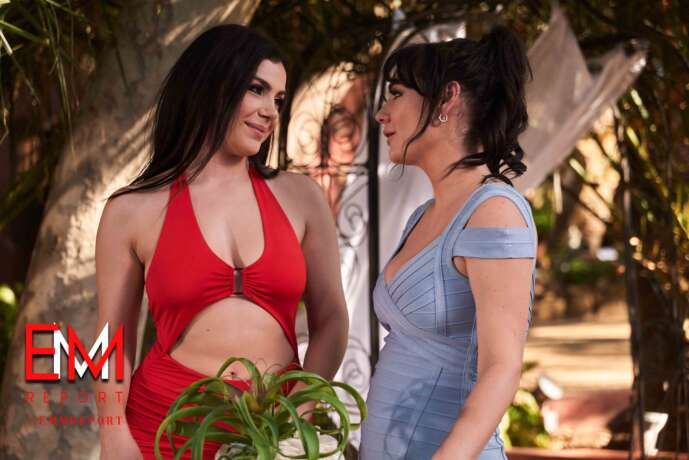
Casting consumed much of pre-production. Karim would suggest performers, only to discover that someone was unavailable, retired or unsuited to the required acts. He did not begin with Valentina Nappy fixed in his mind as Reina. But once he considered her, the uncertainty vanished. “Holy shit, she’s perfect for the role,” he says. “Once I thought of her for the role, I wanted nobody else.” He told Vegas and Susie that without her, “I don’t think it’s even worth it to do this film.”
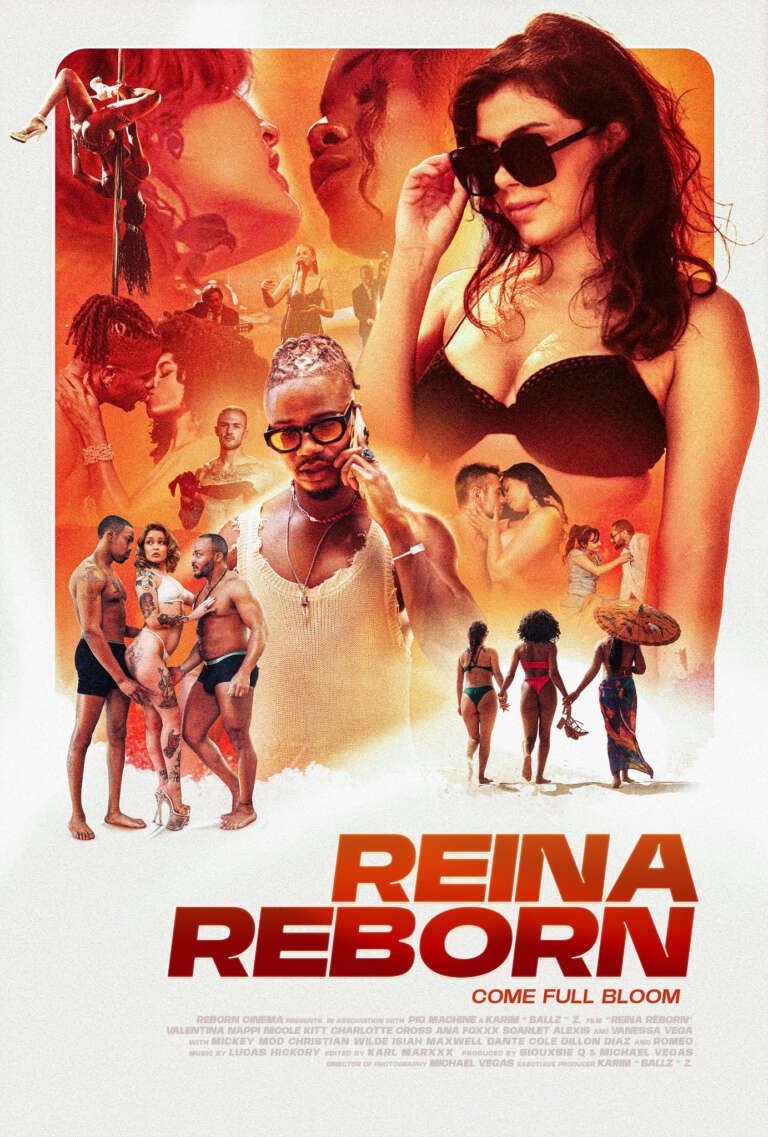
Karim considers Valentina Nappy and Nicole Kitt, who plays Luanna, the two principal female leads. Around them he names Vanessa Vega, Scarlett Alexis, Anna Fox and Charlotte Cross, calling the group “six big-time female stars.” The wider project included 12 major performers, and that abundance became part of his claim that the finished film occupies unusual territory in the contemporary adult business.
Being an unknown male newcomer limited Karim’s direct access before shoot days. He would have liked individual pre-production meetings with the stars, but Vegas and Susie handled most performer communication. “A lot of things were handled by Michael and Susie more than I got to be hands-on with,” he says. He understood the reason even when he disliked the distance: adult schedules were tight, and professional trust had to be protected while he established himself.
The Scenes That Justified the Obsession
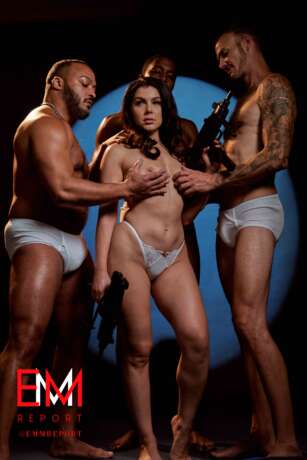
The climax, Real Sluts Share, was one of the reasons Karim wanted to make the film at all. It paired Valentina with guns, required the beach material to be shot on a separate day and reversed a familiar group image by placing three women upright while men crawled toward them. He hopes it will be considered for an outrageous-scene award. “It’s a real over-the-top scene,” he says. “This was the scene with Valentina with guns.”
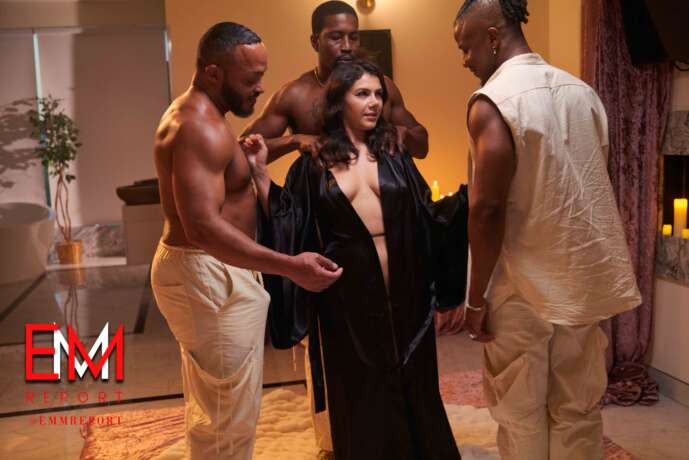
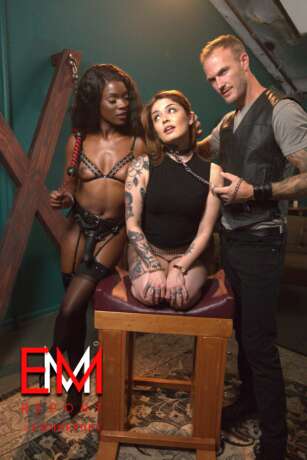
Yet the sequence closest to his heart is Welcome to Our Pleasure Room, the film’s only BDSM scene. Karim had rejected the expected concrete-dungeon look and wanted a richer environment. The dark green room, the performers and the music came together better than he imagined. “It just looked so good,” he says. “It looked visually stunning in so many ways.” The irony delights him because he is not especially drawn to BDSM: “My one BDSM scene really just blew my mind.”
That scene placed Anna Fox and Christian Wilde in a male-female dominant couple with Vanessa Vega as the submissive partner. Elsewhere, Nicole Kitt performs a striptease onstage before bringing Romeo into the act in front of an audience. Karim resists choosing a single favorite because the film was built as a succession of distinct musical worlds. “I really love every single scene in the film,” he says. “Every scene in the film is just really, really, really freaking cool.”

Sixteen Songs and a Licensing Education
Music was not decoration; it was the film’s governing grammar. Karim wanted sex scenes edited to roughly the length of songs, with the music sometimes dominating or entirely replacing production audio. He entered the process assuming a filmmaker could pay a few thousand dollars and secure almost any desired track. “I went into this thinking that you just pay some amount of money,” he says. The reality was 16 songs, only two licensed from existing catalogs and 14 created specifically for the film.
The turning point came during planning for the jazz-club scene. Karim wanted a live band to play a Brazilian bossa nova standard and assumed anyone could simply record a cover. The first band was unavailable, which brought Lucas Hickory and his musicians into the project. Hickory immediately warned him that they could not use the composition without the necessary rights. “Dude, you can’t do that,” Karim remembers him saying. Hickory instead offered to write an original bossa nova piece shaped around the desired mood.
The performance convinced Karim to continue the partnership. “His band was awesome. Music for that scene was awesome,” he says. Hickory came to believe in the project and led the creation of the remaining original material. Karim still pursued multiple licensing requests and discovered how many writers, producers and rights holders might need to approve a single track. “That was definitely an eye-opener to me,” he says. “I didn’t know how hard it was to license music for films.”
In Welcome to Our Pleasure Room, the song itself created an editing opportunity: it appears to end, settles down, then returns harder. Karim and the editor built the scene around that false ending and resurgence. “It just worked so well,” he says. The moment captures the film’s underlying method—image, action and music designed as one piece rather than a conventional scene with a song laid over it afterward.

The Crash After Production
When shooting ended, Karim did not move smoothly into post-production. The manic energy that had carried him through the idea and production gave way to depression and disengagement. “I feel like after production, I kind of…just lost touch with it completely,” he says. He sent footage to an editor, Karl Marx, asked for a first cut and then sometimes failed to respond. “I just didn’t even want to look at the content,” he says. “I just wasn’t in a good space.”
The delay was not creative indifference; it was the other side of the same bipolar cycle he had already identified as part of the film’s origin. For the first months, he describes his participation as “pretty terrible.” The editor would send material, and Karim would leave it without feedback. Eventually he re-entered the work and became exacting. “Once I got into it, and I started working with him, I was all in,” he says. He went through the film closely with Karl Marx and Zach, scrutinizing the decisions he had once avoided.
The post-production path included three broad versions, then picture lock, color and sound; Karim allows that picture-lock adjustments could make it four cuts. The long process did not merely finish the film. It changed how he understood the cost of his original confidence. The man who thought he could jump in and direct everything now knew how much labor existed after the last day on set—and how difficult it could be to summon the mental energy to face it.

The Film He Wishes He Had Also Made
Karim’s largest practical regret is the absence of a soft-core version. “I wish I made a soft version,” he says. Because the film is visually elaborate and music-driven, he believes the existing footage may contain enough non-explicit coverage to construct one, although it would have been easier if the camera team had known to gather that material during production. His wife has repeatedly encouraged the idea: “Maybe this would work out with a soft-core version.”
He is cautious about committing until the original film finds a larger audience, but the conversation clearly reopens the possibility. “You definitely have me thinking more about doing the soft-core version,” he says. “I am going to revisit that idea.” The barrier is partly money and partly the emotional weight of returning to a project that already demanded so much. He would need to speak with the editor, assess the footage and decide whether strategic re-editing—or even limited reshooting—could open the film to viewers who would embrace the style but not the explicit imagery.
Karim has already made another editorial response to audience feedback. Some viewers found the opening engaging but became lost when the middle shifted into vignettes not directly tied to Reina, Luanna and Luciano. He therefore created a shorter, more plot-focused cut that removes some stand-alone scenes. “It basically just cuts out some of those scenes,” he says, keeping the central character stories in view. The two versions expose the project’s tension between narrative feature and musical anthology—both deliberate, but not equally legible to every viewer.
One and Done Meets Reborn Cinema
The agreement with his wife was explicit: one feature, then stop. “I’m doing this one film, one and done,” Karim says. Production only hardened that view. He had heard filmmakers describe the process as addictive, but Reina Reborn left him less eager to repeat it. “That was a lot more than you expected,” he says. “I don’t think I could go through with it again, or at least not with the same level of passion.” For nearly two years, he estimates, the film occupied more than half of his daily thoughts. He does not believe he could top that obsession on command.
RebornCinema.com was named broadly because the plan could extend beyond a single title. Karim imagined releasing behind-the-scenes material gradually, presenting full-length versions of the film’s scenes, licensing existing work that fit his taste and perhaps funding a sequel scene if the economics and his marriage allowed it. “I wanted it to all be like my flavor,” he says. “I wanted it to be a website where I could go to get my favorite porn.”
The commercial structure reflects his reluctance to promise what he cannot supply. The site does not use recurring subscriptions because Karim cannot guarantee a new release every month. “I wouldn’t feel justified having recurring subscriptions” without that certainty, he says. The full-length scenes answer another difference between the feature and conventional viewing: in the movie, sequences are shortened to songs and sometimes contain no sex audio, while many viewers want longer performances with the performers themselves audible.
For now, additional production has not made financial sense. Karim remains interested in a sequel scene and in content expansion, but he distinguishes imagination from current reality. “Right now it doesn’t,” he says of the economics. The website remains the place where the singular film can be seen, expanded and reconsidered without pretending that the next feature is already on the way.
A Ten Percent Chance and a Climate Cause
Karim entered the project expecting it to be difficult, but not this difficult, expensive or commercially narrow. “I give this like a 10 percent chance of success, and I am okay with that,” he remembers deciding. Even failure seemed preferable to leaving the dream untouched. “I need to go chase this dream and see what happens,” he says. What surprised him was not merely the difficulty of recovering the budget, but “that huge of a gap” between the investment and the return.
Profit, however, was never the only measure. The earliest music-video thought had been connected to climate change, a cause Karim considers one of humanity’s defining challenges. He rejects the idea that individual household virtue can substitute for policy. “It’s just an unrealistic expectation that everybody’s going to do their part and somehow this is going to get solved,” he says. “It needs to be at the policy level.” Scientists and artists have already warned the public; his question was whether an audacious adult film might reach people through a different door.
His ambition was deliberately oversized: “I wanted to make the greatest adult film.” He points to the number of hardcore scenes, the 16 songs, the dozen major performers and the film’s scale as evidence that Reina Reborn is unusual, even while acknowledging that productions such as Pirates carried larger budgets. The climate strategy sounds absurd to him even as he defends it. “What kind of a crazy idea is that—to make an adult film and think it’s going to make a difference about climate change?” he asks. Then he answers with frustration: “What exactly is working right now?”
Karim understood that some advocates might see pornography as the wrong kind of attention. His counterargument is experimentation. “It doesn’t seem like anything else is working, so why don’t we try something else?” he says. He imagined that the very insanity of the gesture—someone making this elaborate film for this reason—could turn heads, generate conversation and perhaps raise money. The audience is not yet large enough to prove the theory, but he sees momentum and hopes award season will bring nominations the work deserves.
The Measure of Making It Real
Reina Reborn did not follow a credible career plan. It began with a film reference, cryptocurrency gains, a financial wipeout, a tax bill, a return to the office and a man furious with himself for wasting a rare window of freedom. It survived because his wife reluctantly supported the depth of his belief, because an unsuccessful producer relationship led accidentally to Michael Vegas, because Vegas and Suzie helped convert an amateur script into a production, and because Karim kept moving through problems he had never learned to anticipate.
He remains private enough to hide the project from his workplace and candid enough to place bipolar disorder inside the account rather than outside it. He does not pretend the obsession was purely heroic. “It was like more than 50 percent of my thoughts on a daily basis,” he says. Nor does he pretend the result has solved its financial or environmental ambitions. He made the film, watched the work overwhelm him, returned to it, completed it and now faces the less cinematic problem of persuading people to look.
That may be why the simplest fact carries so much weight: the film exists. Karim began as the person most likely to be ignored—the unknown married father proposing a Portuguese-language adult epic in a country he had never visited. He ended with a cast, a 15-day production history, 16 songs, multiple cuts, a website and a finished artifact that he believes has no close comparison. “There is really nothing like it,” he says. On the fundamental question of whether his impossible idea became the film he imagined, his answer is direct: “I think I did in the end.” The idea was crazy. The journey was crazier. He followed both all the way to the screen.

Follow us on twitter: @emmreport, instagram @emmreport, tiktok@emmreport





+ There are no comments
Add yours